

What Is a Ketubah? The Complete Guide to the Jewish Marriage Contract
A ketubah (Hebrew: כתובה, plural ketubot) is the Jewish marriage contract — a document, traditionally written in Aramaic, that records the couple's wedding and the obligations one spouse accepts toward the other. Signed by witnesses just before the ceremony and read aloud under the chuppah, the ketubah is one of the oldest continuously used legal documents in Jewish life — and, in its decorated form, often the first piece of art a couple hangs in their home.
This guide covers everything engaged couples ask about the ketubah: its meaning and history, what the text actually says, who signs it and when, whether it's legally binding, how traditional and modern ketubot differ, and what to know before choosing one from a ketubah collection for your own wedding.
Ketubah Meaning: What the Word Actually Says
The word ketubah comes from the Hebrew root k-t-v (כתב), “to write” — it literally means “that which is written.” The name is the point: at a time when most agreements in the ancient world were spoken, Jewish tradition insisted that a husband's obligations to his wife be put in writing, witnessed, and handed to her to keep. The ketubah is not a certificate of marriage in the modern sense; it is a unilateral contract in which the groom commits to specific duties, created above all to protect the bride.
A Brief History: 2,000+ Years of Written Protection
The ketubah is ancient even by the standards of Jewish ritual objects. Aramaic marriage documents remarkably similar to today's ketubot survive from as early as the 5th century BCE, and the rabbinic form of the text was standardized in the Talmudic era. The National Library of Israel's ketubot collection — one of the world's great archives of these documents — shows how little the core text has changed across centuries and continents, even as communities from Venice to Cochin to Herat decorated their ketubot in wildly different artistic styles.
That artistic tradition is why the ketubah occupies a unique place among Jewish wedding objects: it is simultaneously a legal document, a ritual text, and a work of art. Illuminated ketubot from Italy, papercut designs from Eastern Europe, and vividly painted examples from Persian and Indian communities all testify to the same instinct — a contract this important deserved beauty.
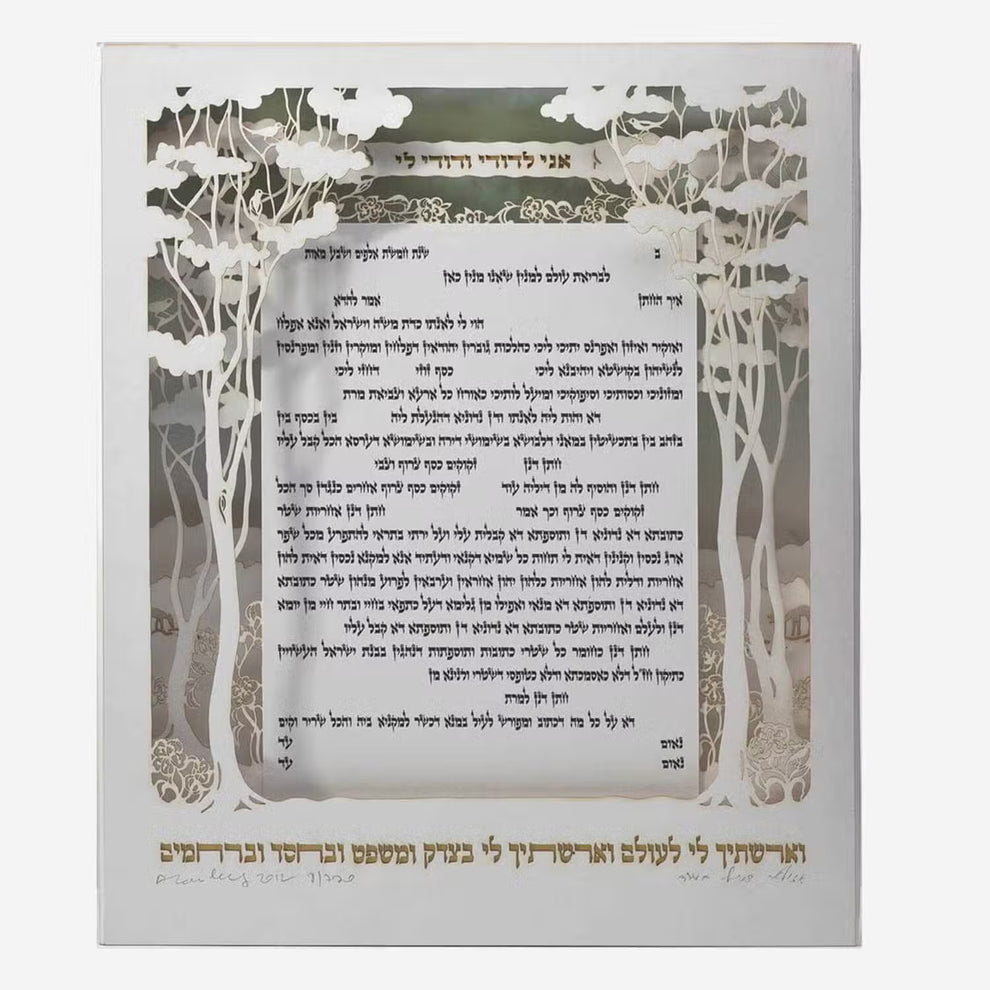
What Does the Ketubah Text Say?
The traditional Aramaic ketubah text records four essential things:
- The facts of the wedding — the Hebrew date, the city, and the names of the bride, groom, and witnesses.
- The groom's core obligations — to provide his wife with food, clothing, and marital rights throughout the marriage.
- The financial settlement — a sum (historically 200 zuz for a first marriage) payable to the wife if the marriage ends through divorce or the husband's death. In its era, this was a strikingly progressive protection: it made divorce costly and guaranteed the wife independent means.
- Additional amounts and the dowry — voluntary additions by the groom and a record of what the bride brings into the marriage.
Modern couples choose among several text versions, and this choice matters more than the artwork: Orthodox ceremonies use the traditional Aramaic text; Conservative ketubot often add the Lieberman clause, a 20th-century provision addressing religious divorce; and Reform, egalitarian, interfaith, and same-sex texts typically replace the one-sided legal formula with mutual commitments in Hebrew and English. Always confirm the text version with your officiant before ordering — it is the one element of a ketubah that cannot be fixed after the wedding.
Is a Ketubah Legally Binding?
In the United States, no — a ketubah is a religious document, not an enforceable civil contract. American courts have occasionally weighed ketubah clauses under ordinary contract law, but no couple should rely on it in place of civil legal instruments. Israel is the notable exception, where the ketubah carries weight under civil as well as religious law.
That answer surprises many couples, because the document looks and reads like a contract. The honest framing is that the ketubah's force today is moral, communal, and religious: it declares obligations in front of witnesses and a community, which is precisely the mechanism the Talmudic rabbis intended.
The legal question does intersect with real life in one place: Jewish divorce. Ending a Jewish marriage requires a separate document called a get, arranged through a beit din (rabbinical court); the ketubah's ancient financial pledge is not what modern divorce settlements are built on. Couples who want religiously meaningful and civilly enforceable protections generally pair their ketubah with standard legal agreements — a rabbi and a family lawyer each handle their own lane.
None of this diminishes the document. If anything, freeing the ketubah from civil enforcement is what allowed it to evolve into the personalized, artistic declaration most couples want today
Who Signs the Ketubah — and When?
The ketubah is signed shortly before the ceremony at a gathering often called the ketubah signing or tisch, in the presence of close family. In traditional practice, the signatures that matter are those of two witnesses (edim) — observant adult Jews who are not related to the couple or to each other. The groom formally accepts the obligations through a symbolic act called kinyan (typically lifting a handkerchief offered by the rabbi) rather than by signing. In Conservative, Reform, and egalitarian weddings, the couple and the officiating rabbi usually sign as well.
Under the chuppah, the ketubah is read aloud — traditionally marking the transition between the ceremony's two halves — and then handed to the bride. It shares that moment with the other ritual objects of the Jewish wedding: the tallit the groom may wear under the chuppah, the rings, the kiddush cup over which the blessings are recited, and the glass broken at the ceremony's close.

Traditional Ketubah vs Modern Ketubah: Choosing a Style
Every ketubah pairs a text with a work of art, and the artwork is where couples express themselves. The two broad directions:
- Traditional ketubot draw on centuries of illuminated-manuscript design — ornate borders, floral scrollwork, micrography, and classical Jewish symbols like the Tree of Life, Jerusalem, and the seven species. They suit formal ceremonies and couples who want their document to look like the historical artifacts it descends from. Browse traditional ketubah designs to see the style.
- Contemporary ketubot reinterpret the form — watercolor, minimalist typography, abstract color, and dimensional techniques like laser-cut and hand-cut paper. Jerusalem artist Danny Azoulay's Interlace Ketubah, with its woven papercut border around a circular text panel, is a good example of how far the art form has traveled while keeping the text at the center. Explore the full range of contemporary ketubah designs for modern ceremonies.
There is no halachic preference between the two — the text is what carries the tradition. Choose the artwork you'll still love on your wall at your twenty-fifth anniversary.
|
Text version |
Language |
Typically used by |
Key feature |
|
Traditional (Orthodox) |
Aramaic |
Orthodox weddings |
The codified Talmudic text, unchanged |
|
Conservative |
Aramaic + clause |
Conservative weddings |
Adds the Lieberman clause addressing divorce (agunah) protections |
|
Egalitarian / Reform |
Hebrew + English |
Reform & unaffiliated couples |
Mutual promises; both partners take on obligations |
|
Interfaith |
English + Hebrew |
Interfaith couples |
Universal language of partnership; no halachic formulas |
|
Anniversary / vow renewal |
Varies |
Married couples |
Commemorative text; no witnesses required |
How to Choose a Ketubah: A Buyer's Checklist
- Confirm the text version first. Your officiant's approval of the text (Orthodox, Conservative with Lieberman clause, Reform, interfaith, same-sex, or humanist) comes before any design decision.
- Order early. Personalized ketubot are completed with your names, date, and location — allow several weeks before the wedding, longer for hand-finished or custom pieces.
- Check the personalization details twice. Hebrew names (including mothers' and fathers' names where the text requires them), the Hebrew date, and the location must be exact — errors in the text are the one thing that can't be framed away.
-
Think about where it will hang. Size and palette should suit your home, not just the ceremony — this document will be on your wall for decades.
- Coordinate the rest of the ceremony while you're at it. Most couples sort their ketubah in the same round as wedding kippot for guests and a kiddush cup for the blessing — it's easier to match styles and palettes when you're not doing it in three separate trips.
- Ask questions before you order. A good Judaica shop will walk you through text options and personalization — contact us and we'll help you get every detail right.
The Ketubah After the Wedding
Frame the ketubah behind UV-filtering glass and hang it away from direct sunlight — those two choices do more for its lifespan than anything else. Paper, inks, and papercut layers all fade and warp under UV exposure and humidity swings, so treat the document the way a framer treats any work on paper: acid-free matting, sealed backing, and a wall that doesn't get afternoon sun.
Where couples hang it is personal. The bedroom is the traditional favorite — the ketubah is, after all, a document about the marriage rather than the wedding — but entryways and living rooms are common in homes where the couple wants guests to see it. There is no rule; there is only the wall you'll pass every day — often near the mezuzah on that same doorway, since many couples order both around the same time.
Two edge cases are worth knowing. If the ketubah is ever lost or destroyed, Jewish law calls for a replacement — a document called a ketubah de'irkhesa is written and newly witnessed, because tradition holds that a couple should not live together without one. And after a divorce, the decorated document has no prescribed fate; the religious formalities happen through the get, not the ketubah.
Photograph the signed ketubah at high resolution before it goes into the frame. It takes two minutes at the wedding and guarantees the text, names, and signatures are preserved no matter what happens to the paper.
Final Word
The ketubah is the rare wedding object that is at once ancient contract, sacred text, and lifelong art. Understanding what it says and how it works makes choosing one far more meaningful than picking a decoration. When you're ready, explore our full collection of ketubot — traditional and contemporary, with text options for every kind of ceremony.
FAQ
What does a ketubah say?
A traditional ketubah, written in Aramaic, records the date and place of the wedding, the names of the couple and witnesses, and the groom's obligations to the bride — to provide her with food, clothing, and marital rights, plus a financial settlement payable if the marriage ends. Modern texts vary by denomination: Conservative versions often add the Lieberman clause, while Reform, egalitarian, and interfaith texts typically express mutual vows of love and partnership in Hebrew and English.
Is a ketubah legally binding?
In the United States, the ketubah is a religious and ceremonial document — your civil marriage license is a separate legal requirement, and secular courts have been inconsistent about enforcing ketubah terms. Within Jewish law (halacha), however, it is a genuine contract: traditional communities treat its obligations as binding, and in Israel, rabbinical courts can give its financial terms legal effect.
Who signs the ketubah?
In traditional practice, two witnesses (edim) sign the ketubah — observant adult Jews who are not related to the couple or to each other. The groom formally accepts the obligations, though he traditionally does not sign. In Conservative, Reform, and egalitarian ceremonies, it's common for the couple themselves and the officiating rabbi to sign as well, often alongside the two witnesses.
When is the ketubah signed?
The ketubah is signed shortly before the wedding ceremony, at a gathering often called the ketubah signing or tisch, attended by the couple's closest family and the witnesses. It is then read aloud under the chuppah — traditionally between the two parts of the ceremony — and presented to the bride.
What happens to a ketubah after divorce?
In a Jewish divorce, the religious dissolution is accomplished by a separate document called a get. The ketubah's financial obligations historically came due at that point — that protection for the wife was its original legal purpose. In most modern communities the settlement is symbolic, and the decorative ketubah itself is simply retained or set aside; it has no further ritual function once the marriage ends.
What do you do with the ketubah after the wedding?
The ketubah is given to the bride (or kept by the couple) and is traditionally displayed in the home — which is why couples invest in a beautiful artistic piece. Framing it under UV-protective glass, away from direct sunlight, preserves the artwork and ink. If a ketubah is lost during the marriage, tradition calls for arranging a replacement, known as a ketubah d'irkesa.
Do interfaith and same-sex couples have ketubot?
Yes. Contemporary ketubah texts include interfaith versions, gender-neutral and same-sex versions, and secular humanist versions expressing the couple's mutual commitments. The right text depends on your officiant and community, which is why couples should confirm the text version with their rabbi or officiant before ordering.
How much does a ketubah cost?
Simple printed ketubot start under a hundred dollars, while limited-edition artist prints, papercut designs, and hand-embellished pieces typically range from several hundred to over a thousand dollars. Because the ketubah is displayed in the home for a lifetime, many couples treat it as their first piece of art together rather than a wedding expense.